
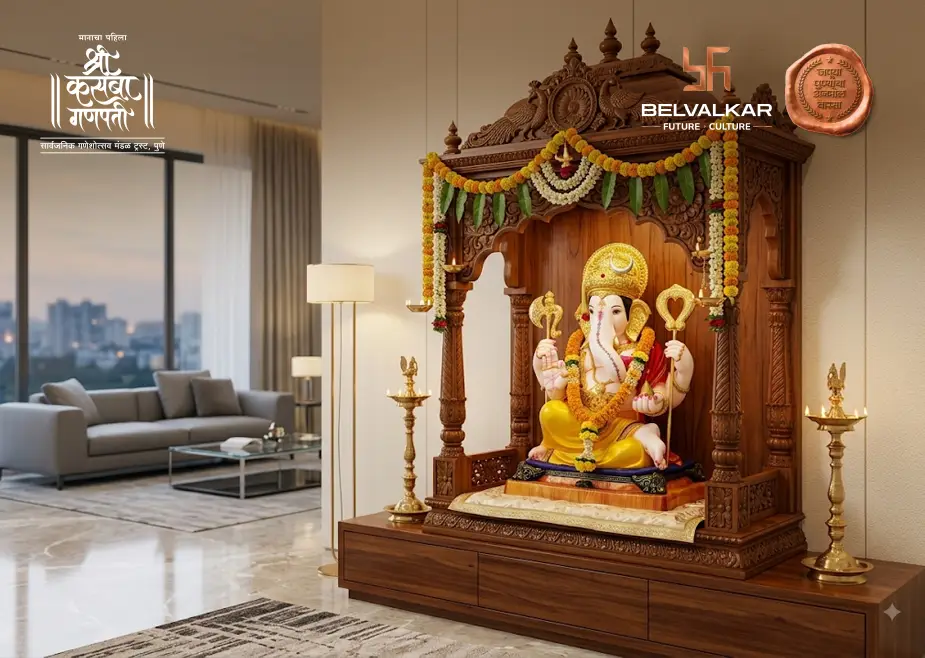
Wake up early enough during Ganeshotsav in Pune and you can almost feel it before you see it. Days before the rest of the city catches up, something shifts near Kasba Peth. The lanes fill up a little earlier, the flower sellers set up a little sooner, and everyone just seems to know why. This is where the festival truly starts. Not officially, not on a poster anywhere, but in the way it has always worked. Kasba Ganapati gets the first bow, every single year, before a single other pandal even lights a lamp. The idol sits in Kasba Peth, the same small pocket of the city where Pune itself was born almost 400 years ago, and every
Ganeshotsav still opens from that exact spot.
This year, that old story gets a small but heartfelt addition. Belvalkar Housing Group has come on board as the Cultural Partner for Ganeshotsav 2026 at Kasba Ganapati, supporting the temple’s cultural and heritage work through the festival.
It is a simple idea, really, once you sit with it. Growing as a city should never mean forgetting where you came from. That is more or less what brought these two together.
Where it started
To understand why this matters, you have to go back to the 1630s. Near the home of a man named Vinayak Bhatt Thakkar, in what we now call Kasba Peth, a rare idol of Ganpati was discovered. Mata Jijabai, Shivaji Maharaj’s mother, saw it as a sign of good fortune and had a small shrine built right there. Shivaji Maharaj himself took part in the prayers. And from that point on, a habit formed. Before he left for any battle, he would stop at this very shrine first, to seek its blessings.
That is the reason people still call Kasba Ganapati the gram daivat of Pune, its guardian deity. It was never just another idol in another temple. It has always been something closer to home than that, almost like an elder of the family the whole city shares.
The group that looks after the temple today and runs the festival every year, Shri Kasba Ganpati Mandal, was formally set up in 1893. That is the very same year Lokmanya Tilak turned Ganeshotsav into a public festival, and he built the idea on what Kasba Ganapati already meant to people. Within a year, nearly 108 Ganesh mandals had sprung up across Pune. That same energy is still alive today. Every year, thousands of people move through the old, narrow lanes of the city to see their favourite Ganpatis, and it all still begins with Kasba Ganapati leading the way, exactly as it has for generations.
More than one festival a year
What is easy to miss, if you only know Shri Kasba Ganpati Mandal from Ganeshotsav, is how much it does the rest of the year too. Over the decades, the Mandal has quietly built up work in education, helped push social causes forward, supported women in getting more opportunities, run programmes for the community, and given young artists a place to be seen and heard. Ganeshotsav is the loudest, most visible part of what it does, but far from the only part.
That is worth knowing, because it changes what this year’s support actually means. It is not just about one festival lighting up for a few days. It is about backing a group that has spent well over a century showing up for Pune in more ways than one.
Why it made sense
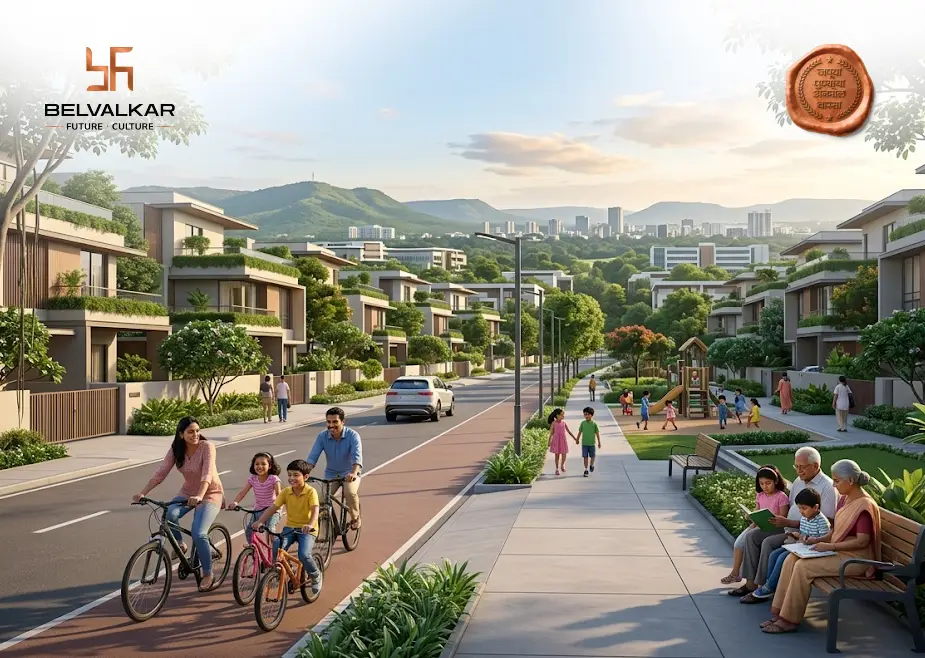
Belvalkar Housing Group has grown alongside Pune too, in its own way, working across the city’s older neighbourhoods for decades and getting to know the people and communities that live there, not just the land.
Prabhat Road and Bhandarkar Road are two of those old, quiet, tree lined streets where the group has worked. Law College Road, close to Fergusson and SP College, is another, always busy with students and families who have lived there for years.
Kothrud, once a sleepy green suburb, has slowly turned into one of the city’s most sought after addresses, and Erandwane, sitting near the river and Karve Road, carries that same old Pune rhythm. Navi Peth and Dahanukar Colony are cut from the same cloth, places where new homes have come up on land that has quietly held generations of families before them.
All of these streets sit in the shadow of the same city that Kasba Ganapati has watched over since the 1630s. So when the idea of coming on as Cultural Partner for this year’s Ganeshotsav came up, it did not feel like stepping into something unfamiliar. It felt closer to showing up for a neighbour whose festival has meant something to this city for generations, long before Belvalkar Housing Group ever built a single home there.
A city that keeps changing
Pune is changing faster than it ever has. New roads and metro lines are going up. Old buildings are coming down and new ones are taking their place. Whole neighbourhoods look different than they did even ten years ago, and the way a young Punekar experiences the city today is nothing like how their grandparents experienced it.
But a few things still manage to connect all of them anyway. Ganeshotsav is one of those things. A grandparent who has watched the festival for sixty years, a parent who grew up dancing behind the visarjan procession, and a kid who now follows the same festival through a phone screen are all, in their own way, part of the same tradition. Nobody planned it that way. It just happens, year after year.
That is really the point of this whole idea. Nobody is trying to keep things exactly as they were. That would not even be possible. The real job is making sure the meaning behind these traditions does not get lost while everything else around them changes.
Old streets, new homes
On the surface, a nearly 400 year old temple and a company that builds homes do not sound like they have much in common. But look a little closer and they are both doing something similar in their own way. They are both trying to hold onto something old while still giving it room to grow.
A city’s heritage does not live only in its old buildings or monuments. It lives in its neighbourhoods, its festivals, its rituals, its stories, and in the people who keep showing up for all of it, year after year. Puneri varsa, the heritage that this city carries, does not just show up once a year when the festival comes around. It lives quietly in these same streets all year long, in the old trees, the narrow lanes, and in how much care goes into anything new that gets built there.
Carrying the stories forward
The way people experience culture is changing too. A story that used to travel only through a family or a neighbourhood can now reach someone sitting in another city, or another country, in seconds. Photos and short videos shared online are not just posts. For a festival like this, they can work almost like a small archive, something a young Punekar who has never seen Kasba Ganapati up close can stumble onto, or something that reminds someone far from home what this time of year feels like back in Pune.
That is part of what this partnership hopes to do too, in a small way. Not just mark the festival, but help its stories travel a little further than they used to.
The other four Manache Ganpati
- Kasba Ganapati may be first, but it is not alone. It is one of five Manache Ganpati, the five Ganpati mandals of Pune that carry the highest honour during the festival, and each one has its own story worth knowing.
- Tambdi Jogeshwari holds the second spot. Its roots go back to the 15th century, and it honours the goddess long seen as Pune’s own presiding deity. Every year, the old idol is immersed in water and a new one takes its place, a tradition that has carried on without a break. Lokmanya Tilak gave it this second rank all the way back in 1893.
- Guruji Talim comes third, and its story is a lovely one. It started in 1887, when a Hindu family and a Muslim family came together and set it up as one shared effort. All these years later, it still stands for two communities coming together over one festival.
- Tulshibaug Ganpati takes the fourth spot. It began in 1901 right at Pune’s busy Tulshibaug market, and its idol towers 13 feet tall. In 1975, it also became the very first in Pune to use a glass fibre statue, something quite new for its time.
- Kesariwada Ganpati rounds off the list at fifth. Lokmanya Tilak set this one up too, in 1894, inside the same wada that played its own part in India’s freedom struggle. Even now, its story pulls straight back to that history every single year.
Together, these five mandals carry the heart of Pune’s Ganeshotsav, and each one has earned its place through its own history, not just its rank. If you want to know more about all five, along with the exact Ganeshotsav 2026 dates and rituals, take a look at Belvalkar Housing Group’s guide to Pune’s 5 Manache Ganpati. And for live updates from Kasba Ganpati itself through the festival, the temple’s own Instagram account, @shrikasbaganpati, is worth a follow.
One festival, and what comes after
Ganeshotsav 2026 is where this partnership begins, but it is not really meant to end there. Culture is not something that happens once a year and then goes quiet. It lives in conversations, in community work, in art, in the streets people walk every day, and in the people who keep choosing to look after it.
lass=”yoast-text-mark” />>Shri Kasba Ganpati Mandal and Belvalkar Housing Group both seem to see this the same way, that there is more to explore together than just one festival, and that this year is more of a starting point than a finish line.
Because in the end, legacy is not only about what gets handed down to you. It is about what you choose to carry forward, and who you choose to carry it with.
Frequently Asked Questions
What is Kasba Ganapati famous for?
It is known as Pune’s first and most honoured Ganpati. It also carries a personal link to Mata Jijabai and Shivaji Maharaj, who prayed here and sought its blessings before setting out on his campaigns.
Why is Kasba Ganapati called the first Manacha Ganpati?
Because it is seen as Pune’s gram daivat, or guardian deity, and its story goes all the way back to how Kasba Peth itself came to be.
When was Shri Kasba Ganpati Mandal set up, and when did Ganeshotsav become a public festival in Pune?
Shri Kasba Ganpati Mandal was formally set up in 1893, the same year Lokmanya Tilak turned Ganeshotsav into a public festival, building on what Kasba Ganapati already meant to the city. Within a year, close to 108 mandals had come up across Pune.
Does Shri Kasba Ganpati Mandal do anything beyond the festival?
Yes. Alongside Ganeshotsav, the Mandal has worked over the years in education, social development, women’s empowerment, community programmes, and giving young artists a platform to be seen.
What is Belvalkar Housing Group’s role in Ganeshotsav 2026?
Belvalkar Housing Group has come on board as the Cultural Partner for Ganeshotsav 2026, supporting the cultural and heritage side of the festival at Kasba Ganapati, in the same old Pune lanes it has been building homes in for years.
Where can I see updates on this partnership?
On Belvalkar Housing Group’s Instagram page, linked above, where the festival photos and updates have been shared.
Which parts of Pune has Belvalkar Housing Group worked in?
Mostly the older, central pockets of the city, including Prabhat Road, Bhandarkar Road, Law College Road, Kothrud, Erandwane, Navi Peth, and Dahanukar Colony.