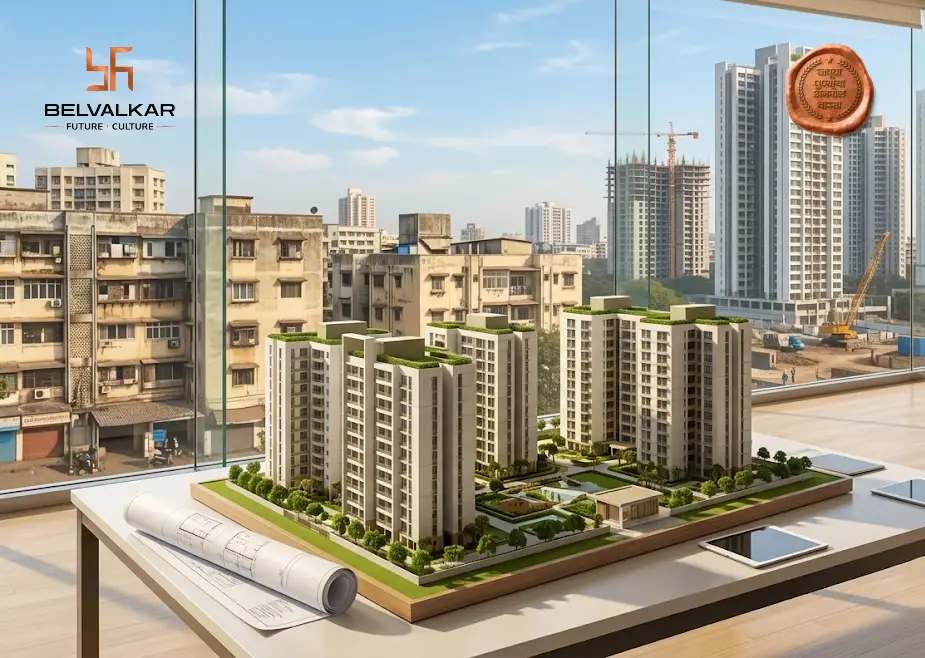


A lot of Pune societies find out about this problem late, usually in their very first meeting with a developer. Everyone’s excited about new flats, a lift and proper parking. Then someone asks for the conveyance deed, and the secretary has no idea where it is. Often it doesn’t exist.
That’s more common than most people think. Plenty of families have lived in the same flat for 30 years, paid every maintenance bill and property tax, and the land under the building is still in the builder’s name. If your society is thinking about redevelopment, this is the first thing to sort out. The way to do it is called deemed conveyance.
What is deemed conveyance?
Deemed conveyance is how a housing society gets ownership of its land and building when the builder never transferred them. A government officer approves the transfer, so the builder doesn’t have to sign anything.
The rule comes from Section 11 of the Maharashtra Ownership Flats Act (MOFA), 1963. The deemed conveyance option was added in 2008, after years of societies being stuck with builders who had disappeared or refused to cooperate. Applications go to the District Deputy Registrar of Co-operative Societies, who is called the Competent Authority under the Act.
Why doesn’t my society own its land already?
The builder was supposed to transfer it and didn’t. MOFA gives builders four months after a society is registered to hand over the land and building. For newer projects that come under RERA, the deadline is three months from the occupancy certificate.
A lot of builders from the 70s, 80s and 90s never did it. Some kept the land on purpose so they could use leftover building rights later, shut their firms. Some passed away and their families didn’t follow up. Nobody in the building noticed, because a missing deed doesn’t affect daily life. You only feel it when you try to rebuild or sell.
How can I check?
Get a copy of your society’s 7/12 extract or property card and look at whose name is on it. If it’s the society, you’re fine. If it still shows the builder or the original landowner, you don’t have conveyance yet. Your committee can also check whether a conveyance deed was ever registered with the Sub-Registrar.
Why does redevelopment need deemed conveyance first?
A society can’t give a developer rights to land it doesn’t legally own. Redevelopment works through a development agreement, where the society lets a developer demolish and rebuild on its plot. If the land is in someone else’s name, that agreement doesn’t hold up.
In real terms, it holds up almost everything that comes after:
- Developers who are serious about the project won’t sign without clear title.
- The Pune Municipal Corporation asks for ownership documents before it approves new plans.
- Banks won’t fund construction on land with an unclear owner.
- The extra FSI and TDR that pay for your bigger flat can only be used by the legal owner.
- The old builder, or his heirs, could still raise a claim halfway through construction. By then everyone has moved into rented flats.
That last point is the one that should worry members most. It’s also why the best redevelopment builders in Pune usually ask about deemed conveyance before they talk about anything else.
Why are so many Pune societies dealing with this now?
Mostly because a whole generation of buildings in the city’s older areas has grown old at the same time.
Walk around Erandwane, Prabhat Road, Model Colony, Shivaji Nagar, Deccan or Kothrud and you’ll see buildings from the 1970s to the 90s everywhere. Many have leaking terraces and cracked plaster, and only a few have lifts. At some point, patching them up costs more than it’s worth.
The rules have also changed in favour of rebuilding. The Unified Development Control and Promotion Regulations (UDCPR) came in across Maharashtra in 2020 and opened up more building rights. That usually means existing members get bigger flats, and the developer pays for the project by selling a few extra homes.
Then there’s the metro. The Vanaz to Ramwadi line runs straight through Kothrud, Deccan and Shivaji Nagar. Plots close to metro stations can get higher FSI under the transit-oriented development rules, which has made redevelopment in Pune much more practical in these neighbourhoods. Many families also want to stay in the area they grew up in, just in a better building. That’s a big reason premium residential projects in Pune are coming up on the plots of old societies.
So more societies are looking at redevelopment, and more of them are finding the conveyance gap for the first time.
How do we apply for deemed conveyance?
You apply to the District Deputy Registrar, the builder gets a chance to object, and the officer passes an order. In practice it goes like this:
- Hold a general body meeting and pass a resolution letting the committee apply.
- Send a legal notice to the builder and the original landowner asking them to convey the property.
- File the application in the prescribed form with your documents and the court fee stamp.
- Go for the hearing. If the builder doesn’t turn up or has no valid objection, the officer can decide in your favour anyway.
- Get the order. The law says this should happen within six months.
- Pay stamp duty and register the deed with the Sub-Registrar.
- Get the 7/12 extract or property card updated to the society’s name.
People tend to forget the last step, and they shouldn’t. Until the land records change, the paperwork isn’t really finished.
What documents will we need?
- Society registration certificate and list of members
- Members’ sale agreements, with proof of stamp duty paid
- 7/12 extract or property card, and the city survey map
- Approved building plan, plus the occupancy certificate if you have it
- A copy of the legal notice sent to the builder
- An architect’s certificate showing built-up area and FSI used
Older societies almost always have a gap somewhere, so don’t worry too much if one paper is missing. Maharashtra has relaxed some of these rules over the years, especially for the occupancy certificate, and a property lawyer can usually find another way to prove the same thing.
How long does it take, and what does it cost?
Six months to a year is a fair estimate, and complete papers make it quicker. You’ll pay the filing fee, legal fees, stamp duty and registration charges. Stamp duty is worked out on the ready reckoner rate, but members usually get credit for the duty they already paid on their own flats. Ask your lawyer for the exact figure early, before the committee promises anyone a budget.
What if the builder can’t be traced or won’t cooperate?
This is the problem deemed conveyance was made to solve. You don’t need the builder’s signature or his agreement. Once the notice has been served and the hearing date has passed, the officer can decide without him. Societies whose builders died years ago, or whose firms no longer exist, have got conveyance this way.
What comes after conveyance?
With the land in the society’s name, you can start planning properly. The usual next steps are a structural audit, a general body vote on redevelopment, hiring a project management consultant, and asking developers for proposals.
Take your time choosing a developer. Look at the buildings they’ve finished, talk to societies they’ve already worked with, and check whether those families moved back in on time. When you compare redevelopment builders in Pune, remember that you’ll be living with this decision for a very long time.
In short
Nobody gets excited about land records, and a conveyance deed won’t give you a new kitchen. But societies that sort it out early tend to have much smoother redevelopment projects than the ones that don’t. If yours is even talking about rebuilding, get the 7/12 extract out and check the name on it.
At Belvalkar Group, we’ve worked on redevelopment in several of Pune’s older neighbourhoods. Societies with their title in order are almost always the ones that move fastest, whichever developer they end up choosing.
Frequently Asked Questions
- What is deemed conveyance in simple words?
It’s a legal way for a housing society to become the owner of its land and building when the builder never transferred them. A government officer approves it instead of the builder. - Do we really need deemed conveyance for redevelopment?
Yes, in almost every case. Developers, banks and the municipal corporation all want proof that the society owns the land before anything moves. - Who gives deemed conveyance in Pune?
The District Deputy Registrar of Co-operative Societies, Pune. Under MOFA, this officer is the Competent Authority. - How long does deemed conveyance take in Maharashtra?
The order should come within six months of a complete application. Once you add registration and land record updates, six months to a year is realistic. - Can we get deemed conveyance if our builder has passed away?
Yes. His legal heirs are sent a notice, and the officer can decide even if none of them respond. - Is an occupancy certificate compulsory?
Not always. It helps, but the rules have been relaxed for older buildings. A lawyer can tell you what else will work. - How do I know whether my society already has conveyance?
Check the 7/12 extract or property card. If the owner listed is your society, you already have conveyance. - Does every single member need to agree before we apply?
No. A resolution passed at the general body meeting is enough for the committee to go ahead. - Can we talk to developers while deemed conveyance is still pending?
You can, and many societies do. Most developers will wait for conveyance before signing the final agreement, though. - What’s the risk of going ahead with redevelopment without conveyance?
Someone with a claim on the land could come forward in the middle of the project. Construction could stop while every member is paying rent somewhere else.