
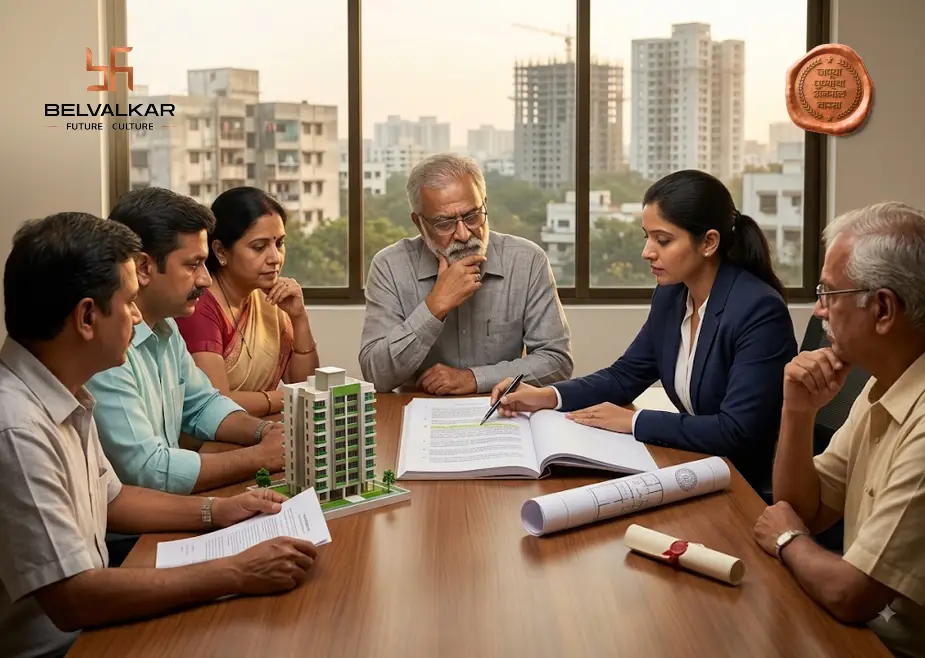
A society committee in Deccan Gymkhana once told their lawyer they were “almost done” with their redevelopment agreement. They had picked a builder and a rough handover date, excited about finally getting lifts and covered parking. The lawyer read the draft in twenty minutes and found no penalty clause for delay, no fixed corpus fund figure, and no exit option if the builder stopped work. They were about to sign a fifteen page promise with almost nothing a court could actually enforce.
This happens more often than people think. Redevelopment in Pune has picked up pace in recent years, especially in older, centrally located societies sitting on land that was never fully built out. Families like the idea of a bigger, safer home in the same neighbourhood. But the gap between a smooth project and a ten year dispute usually comes down to one document. Here are the clauses every society should check before signing.
What Is a Redevelopment Agreement, Exactly?
It is the legal contract between a housing society and the builder chosen to demolish the old building and put up a new one on the same plot. It sets out what the builder must give members, what the society allows the builder to do, and what happens if either side breaks its word.
A normal flat purchase is fully covered by RERA. This agreement usually is not, and that surprises most people. RERA covers the flats a builder sells to new buyers, known as the free sale part of the project. The flats going back to existing members, called the rehabilitation part, mostly fall outside RERA’s direct cover. That gap is exactly why this one document has to do the heavy lifting.
Who Should Read the Redevelopment Agreement Before It Is Signed?
Not just the committee, and never just the builder’s lawyer. The society should bring in its own lawyer and a Project Management Consultant, usually called a PMC, to check the draft first. Under Section 79A of the Maharashtra Co-operative Societies Act, hiring a PMC is not optional. It checks the builder’s finances, reviews the technical proposal, and helps compare bids from at least three developers, flagging missing clauses before the draft reaches a lawyer.
The Clauses Every Society Should Check Line by Line
Carpet Area, Not Just “Bigger Flats”
The agreement should state the exact carpet area of your new flat in square feet, using the RERA definition rather than vague terms like built-up or super built-up area. In well located central Pune societies, members typically gain 25 to 40 percent more carpet area than their old flat. Elsewhere in the city, the gain is usually closer to 15 to 25 percent. If the agreement only says something like “spacious 2BHK,” ask for numbers before you sign.
Rent and Alternate Accommodation During Construction
While your building is demolished and rebuilt, you need somewhere to live. The agreement should fix a monthly rent, state when it starts, and add an escalation clause if construction runs long. It should also say who pays the deposit on your temporary home. Builders sometimes offer a rent that looks fine on paper but does not match real rates nearby, so check it against the local market first.
Corpus Fund: How Much and When It Is Paid
A corpus fund is a lump sum the builder pays the society to help cover future maintenance of the new building. This number should be fixed in the agreement, along with a clear payment schedule. Instalments tied to construction stages are fine, but the schedule needs to be written down, never just promised verbally.
Construction Timeline and Penalty for Delay
This is where the Deccan Gymkhana society almost went wrong. The agreement should list an actual possession date, not a vague phrase like “36 months from approvals.” It should also fix a clear penalty, usually a set amount per month, for every month the builder runs late. Without this clause, a delayed project leaves members with no real leverage.
Bank Guarantee and Security Deposit
Most well written agreements ask the builder for a bank guarantee, usually 20 to 25 percent of the construction cost, held with the society or in escrow. This protects the society if the builder walks away mid project. If a builder resists giving one, treat that as a warning sign.
Additional FSI, TDR, and What the Builder Gets to Sell
The agreement should clearly separate what belongs to existing members from what the builder can sell to new buyers. This means spelling out how much extra FSI and TDR, or transferable development rights, the builder is using, and how many new flats come from that extra space. This is also the part that must carry MahaRERA registration, since it involves selling flats to outside buyers.
Termination, Ownership, and Dispute Resolution
Every agreement needs a clear way out if the builder stops working. A fair clause lets the society end the contract, and appoint a new developer, if construction halts for three months without valid reason. Land ownership should stay with the society until the final transfer to the new building’s association, and the builder’s power of attorney should be limited to permissions only, not broad enough to sell or mortgage the land freely. Last, the agreement should name a way to settle disputes, such as arbitration, plus a force majeure clause that does not excuse ordinary delays.
Parking, Amenities, and Specifications in Writing
Fittings, flooring, parking, lift capacity, and amenities like a garden or clubhouse should all be listed with specifics, since a brochure is marketing material and only the agreement itself is enforceable.
How Much Member Approval Does a Society Need?
A housing society needs 51 percent approval from members present and voting at a special general body meeting to move ahead. Once that mark is crossed, the decision binds every member, even those who voted against it. This threshold is lower than most people expect, which makes the agreement’s quality even more important, since a dissenting minority cannot stop the project once the vote passes.
Where Is Redevelopment Activity Concentrated in Pune?
Activity is not spread evenly across the city. It is concentrated in older, well connected pockets where the original buildings used only a fraction of the FSI now legally allowed.
Kothrud, especially along Karve Road and Paud Road, has some of the busiest redevelopment projects in Kothrud right now. Prabhat Road tends to see smaller, boutique work from redevelopment builders in Prabhat Road Pune, built for long time residents who do not want to leave the lane they grew up on. New projects in Erandwane Pune and new projects in Law College Road are drawing families who want a newer home without changing neighbourhoods. Shivaji Nagar has a genuine mix, with several redevelopment projects in Shivaji Nagar Pune alongside fresh under construction projects in Shivaji Nagar near its courts and offices.
Model Colony is seeing both commercial projects in Model Colony and residential projects in Model Colony come up side by side. SB Road, once mostly commercial, now has redevelopment builders in SB Road Pune working on residential towers too, helped by strong metro and expressway links. Bhandarkar Road rounds out the list, with new projects in Bhandarkar Road steadily replacing older buildings in another central pocket.
Across all these micro markets, societies get better outcomes when they treat the agreement as more important than the brochure. The same logic holds whether you’re comparing the best redevelopment builders in Pune, browsing new residential projects in Pune, weighing premium against luxury residential projects in Pune, or shortlisting the best real estate developers in Pune: paperwork always beats a brochure. Belvalkar Group has worked on several Pune redevelopment projects across these central neighbourhoods, and the pattern holds true everywhere.
Common Mistakes Societies Make When Signing
A few mistakes show up again and again in these disputes. Societies sign a Letter of Intent thinking it is just a formality, not realising it sets the terms for the final agreement. Others skip hiring an independent PMC to save on fees, only to spend far more later on legal fights. And plenty rush to sign before a festival like Ganeshotsav, without checking if the timeline is even realistic.
In Closing
This agreement is not just paperwork standing between a society and its new building. For existing members, it is close to the only real protection they have, since RERA does not fully cover the flats coming back to them. Every clause here, carpet area, rent, corpus fund, timeline, bank guarantee, exit rights, exists because some society learned the hard way what happens when it is missing.
>Read the draft clause by clause, bring in an independent PMC and lawyer, and do not let excitement about a bigger home rush the paperwork. Belvalkar Group has been part of redevelopment projects across Pune’s older, central neighbourhoods for years, and the agreements that hold up best are always the ones written with this care from day one.
Frequently Asked Questions
- What is a redevelopment agreement in Pune?
>>>>>>>>>>>>>>It is the legal contract between a housing society and the builder chosen to demolish the old building and construct a new one on the same plot. It sets out what the builder must provide members and what happens if things go wrong. - Does RERA cover the redevelopment agreement for existing members? Not fully. RERA applies to the flats a builder sells to new buyers. The flats returned to existing society members are mostly outside RERA’s direct cover, which is why the agreement itself matters so much.
- What is a corpus fund in redevelopment? It is a lump sum the builder pays the society, meant to help cover future maintenance costs of the new building. The exact amount and payment schedule should always be fixed in the agreement.
- How much extra carpet area can society members expect? In well located central Pune societies, members typically gain 25 to 40 percent more carpet area than their old flat. In other parts of the city, the gain is usually closer to 15 to 25 percent.
- How much member approval does a society need to start redevelopment? A society needs 51 percent approval from members present and voting at a special general body meeting. Once approved, the decision applies to all members, including those who voted against it.
- What happens if the builder stops work midway? A well written agreement should include a termination clause allowing the society to end the contract, usually if work halts for three months without valid reason, and appoint a new developer.
- Is a Project Management Consultant, or PMC, mandatory for redevelopment? Yes. Under Section 79A of the Maharashtra Co-operative Societies Act, societies must appoint a PMC to assess the project, compare builder proposals, and protect the society’s interests through the process.