
Ask anyone whose building is thinking about redevelopment what they want most, and the answer is usually the same. More area.
A bigger flat. An extra bedroom. A balcony they didn’t have. A parking spot they always needed.
But how much extra do you actually get? And is the number the builder quotes the real one?
This is one of the most confusing parts of redevelopment, because the math involves FSI, TDR, loading, and a dozen other terms most flat owners never hear outside of a society meeting. This guide breaks it down in plain language, so you know what to expect before you sign anything.
First, What “Extra Area” Actually Means
When a builder says “you’ll get 25% more area,” they could mean three different things.
Carpet area is the actual usable space inside your flat. Wall-to-wall. This is what you live in.
Built-up area includes the walls and balconies. It’s bigger than carpet area by about 10 to 15 percent.
Super built-up area includes common spaces like the lobby, staircase, and lifts. It’s even bigger.
In older Pune buildings, most flat owners know their size in built-up or super built-up area. In a redevelopment offer, the developer usually quotes carpet area for the new flat. So if you’re comparing your old 800 sq ft super built-up flat with a new 900 sq ft carpet area flat, the actual jump is much bigger than 100 sq ft.
Always ask: “Is this carpet area or built-up area?” The answer changes everything.
How the Redevelopment Math Works
A developer can build a certain amount of area on any given plot. This is controlled by something called FSI, or Floor Space Index.
Think of FSI like this. If your plot is 1000 sq m and the FSI allowed is 1.1, the developer can legally build 1100 sq m of total flat area on that land.
In Pune, FSI varies by area and road width. Central pockets like Shivaji Nagar, Prabhat Road, and parts of Kothrud often have higher allowances because of wider roads and better infrastructure.
On top of the base FSI, the developer can buy additional development rights (called TDR) from the market and add more area to the project. There’s also something called fungible FSI, where they pay a premium to the municipal corporation to unlock extra area.
All of this adds up to a total area the builder can legally construct. Out of this total:
- A part goes back to existing flat owners. This is where your “extra area” comes from.
- The rest is sold to new buyers. This is how the builder earns their margin.
The more FSI and TDR the project can use, the more area there is for everyone.
What Affects How Much Extra Area You’ll Get
No two redevelopment deals are the same. The extra area you can expect depends on a few things.
- Your plot size. Bigger plots almost always deliver more extra area per flat. A building on a 500 sq m plot and one on a 2000 sq m plot follow very different math.
- Road width in front of your building. In Pune, a wider road usually means higher FSI. A building on a 30-metre road in SB Road or Law College Road can often unlock more area than the same-sized building on an 8-metre internal lane.
- Existing usage vs permissible usage. If your building was constructed decades ago and uses only a fraction of the FSI allowed today, there’s a lot of unused potential sitting in the land. That’s what makes so many redevelopment projects in Pune work out. The old buildings are under-built by today’s rules.
- Number of existing flats. The fewer flats in your current building, the more each flat stands to gain. A 6-flat society splitting the upside is very different from a 40-flat society doing the same.
- Location. Premium belts like Model Colony, Bhandarkar Road, Erandwane, and Prabhat Road often attract stronger offers because sale prices of new flats there are high. Builders can afford to give more to existing owners when their margins on the saleable portion are better.
What Most Pune Flat Owners Can Realistically Expect
There’s no fixed number, but rough ranges help.
In older buildings in premium central Pune areas, existing owners often get somewhere between 25 to 40 percent extra carpet area over their current carpet area. In some cases where land potential is high and the existing building is small, offers go higher.
In areas with lower FSI or smaller plots, the extra offered may be closer to 15 to 25 percent.
These are general ranges, not promises. Every project needs its own feasibility study.
The Catch: What Eats Into Your Extra Area
This is the part builders rarely explain upfront.
- Loading. When a builder says “20% extra carpet,” they’re talking about the flat itself. But the super built-up area, which affects everything from maintenance charges to future resale, often looks very different. High loading means a big gap between carpet and super built-up area.
- Parking. In many Pune redevelopment deals, one car park per flat is standard. But if your family owned two parking slots in the old building, confirm that in writing for the new one.
- Amenities vs saleable area balance. A project with huge amenity spaces (clubhouse, gym, landscaping) often has less area to give back. A leaner project with fewer amenities sometimes offers more square feet. Neither is better. It depends on what you value.
- Corpus and rent. The extra area is only one part of the deal. Monthly rent during construction, the corpus fund, and brokerage also matter. A slightly smaller extra area with a bigger corpus can sometimes be the better offer on paper.
Red Flags to Watch For
A few things should make you pause before signing.
- Offers that promise extra area far above what other builders in your area are quoting. If the number looks too good, it usually is.
- Vague written terms. The agreement should mention carpet area clearly, not just “approximately X sq ft.”
- No clarity on completion timelines or penalty clauses for delays.
- A builder with no past delivery track record in Pune, or only one or two small projects behind them.
Redevelopment is a long process. You’ll be working with this builder for three or four years, sometimes more. Their reliability matters as much as the area they offer.
What Your Society Should Actually Do
Before you say yes to any offer:
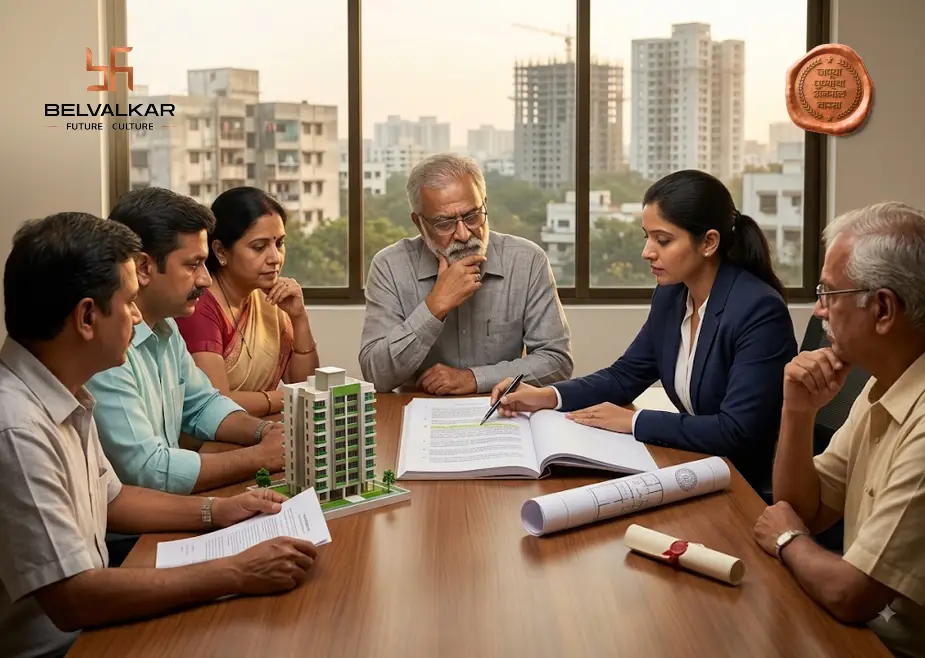
- Get the feasibility report done by an independent architect. Not just the builder’s own report.
- Compare at least three serious builder offers, not just the first one you get.
- Visit past project sites in person. Talk to flat owners who have actually been through redevelopment with the same builder.
- Read the development agreement carefully with a real estate lawyer, not a general one.
A good builder won’t rush you. If someone is pushing you to sign within a week, that alone is a signal.
Final Thought
The extra area you get in redevelopment depends on your plot, your location, your existing building, and the builder you pick. There’s no one-size-fits-all answer. But once you understand the basics of FSI, TDR, and loading, most offers stop feeling like a mystery.
If your society is just beginning to explore the idea, it helps to work with a builder who has done this many times and has a delivery track record across Pune. Belvalkar Group has been building in the city since 1969 and handles redevelopment projects in several Pune neighbourhoods, which usually makes the construction and the paperwork side of things a lot smoother.
Either way, ask questions. Ask a lot of them. This is the biggest financial decision most flat owners will make in their lifetime. You’re allowed to take your time.